HISTORY OF THE REPUBLICAN CENTER FOR MEDICAL DIAGNOSTICS
From the institution's founding in 1988 to the development of a multidisciplinary medical center
The history of the Republican Medical Diagnostic Center began in 1988, when the legislation establishing the institution was enacted. Over the decades, the Center has expanded its structure, technological capabilities, and range of services, while keeping medical diagnostics at the core of its activities. |
1988 — The Background to the Establishment of the Center
The establishment of the Republican Medical Diagnostic Center was part of a broad process to modernize medical diagnostics and reorganize medical diagnostic centers.
On May 19, 1988, the Council of Ministers of the USSR adopted Resolution No. 628 “On the Organization of Medical Diagnostic Centers.” At the republican level, on August 5, 1988, the Council of Ministers of the Moldavian SSR issued Order No. 148-r, authorizing the Ministry of Health to organize, during the period 1988–1989, the Republican Medical Diagnostic Center in Chișinău.
The document set as its objective ensuring a modern level of medical diagnosis and creating the technical and material infrastructure necessary for comprehensive medical examinations of the population.
September 1, 1988 — Official establishment of the CRDM
On September 1, 1988, Order No. 281 of the Ministry of Health of the Moldovan SSR, “On the Organization of the Republican Center for Medical Diagnostics,” established the institution officially.
According to the order, the Center was to be established on the basis of an existing subdivision of the phthisiology and pulmonology complex, and the Ministry of Health’s departments were assigned specific tasks regarding the procurement of medical equipment, staff training, the organization of wards and laboratories, financial support, and the development of infrastructure.
The order also provided for the priority allocation of medical equipment and the training of specialists to operate the new equipment. September 1, 1988, thus marks the official establishment of the Republican Center for Medical Diagnostics.
1988–1989 — Establishment of the technical infrastructure and the team
The period immediately following the establishment of the institution was devoted to the actual set-up of the Center: fitting out the facilities, equipping them with medical equipment, organizing the departments and laboratories, and training the staff.
The organizational documents from 1988 placed special emphasis on the training and continuing education of physicians, laboratory specialists, and technical staff, which were necessary for the use of new diagnostic technologies.
1990 — Development of the advisory component
In 1990, the Consultative Department was established within the Center, which expanded the institution’s scope by integrating specialized medical consultations with diagnostic testing.
1990–2004 — The period of consolidation under the leadership of Chiril Draganiuc
Professor Chiril Draganiuc, who holds a doctorate in medicine and served as Minister of Health, played a pivotal role in the creation and consolidation of the Center; he is described in the institution’s historical records as its founder and first director.
After his term as Minister of Health ended, Chiril Draganiuc headed the Center from 1990 to 2004. During those years, the institution’s structure, professional expertise, and use of modern diagnostic technologies were strengthened.
The 2000s — Continuity and Development of Services
In the 2000s, the Center continued its work and expanded its diagnostic and consulting services.
2010 — A New Chapter in Management
In 2010, Dr. Andrei Testemițanu, a doctor of medicine and associate professor, took over as director of the Republican Center for Medical Diagnostics. The following period was marked by significant investments in the technological modernization of the institution.
2012–2013 — Major technological upgrade
The years 2012–2013 marked an important phase in the modernization of the CRDM. The institution was equipped with modern diagnostic equipment, including a CT scanner, an MRI system, and 4D ultrasound machines.
The integration of new technologies has expanded the Center’s diagnostic capabilities and contributed to the development of imaging and functional services.
2014–2020 — Diversification of Diagnostic Capabilities
During this period, CRDM offered a wide range of services and diagnostic procedures, including magnetic resonance imaging, computed tomography, mammography, nuclear medicine, echocardiography, functional diagnostics, ultrasonography, and endoscopy.
2021–2026 — Continuity and Modernization
The center has continued to expand its diagnostic, consultative, and laboratory services, as well as to modernize its infrastructure and medical equipment.
CRDM Today
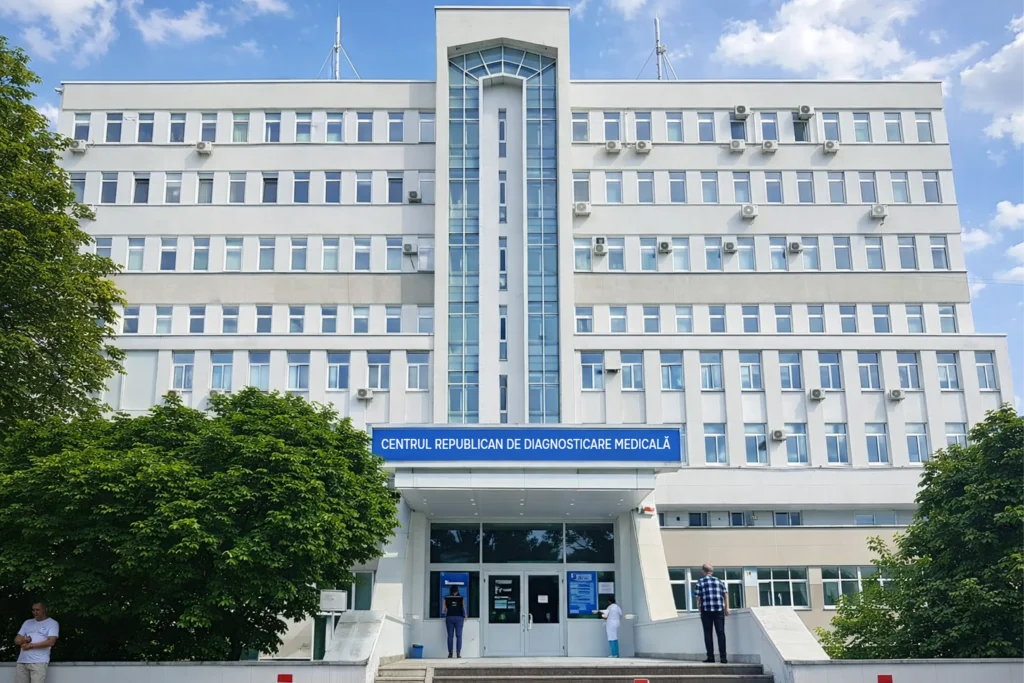
Thirty-eight years after its establishment, the IMSP Republican Medical Diagnostic Center continues the work it began in 1988, offering diagnostic services, specialized medical consultations, and clinical diagnostic laboratory services.
Currently, patients have access within the facility to imaging and diagnostic tests, including radiology and computed tomography, magnetic resonance imaging, ultrasonography, echocardiography, and studies of the major blood vessels, as well as functional diagnostics, endoscopy, and nuclear medicine, in addition to specialized medical consultations and laboratory tests.
From the establishment of a modern medical institution in the late 1980s to the Center as it stands today, the history of the CRDM reflects the continuous development of medical diagnostic capabilities in the Republic of Moldova.