
Nuclear medicine
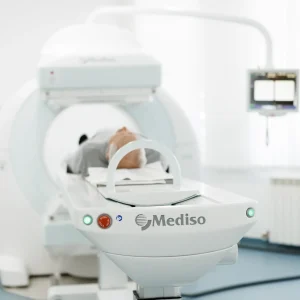
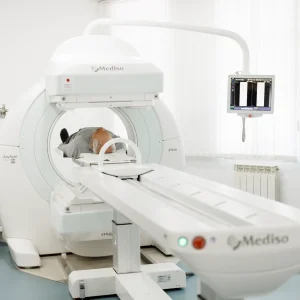
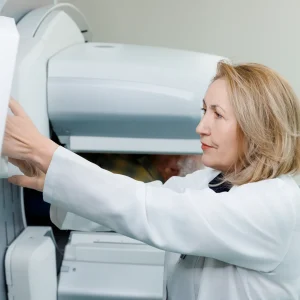
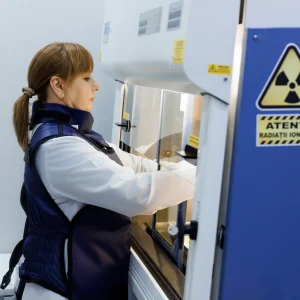
Nuclear medicine is a branch of medical imaging that uses radioactive substances (radiopharmaceuticals) for diagnosis and treatment.
Scintigraphy is a functional imaging method that allows the evaluation of physiological and metabolic processes in the body.
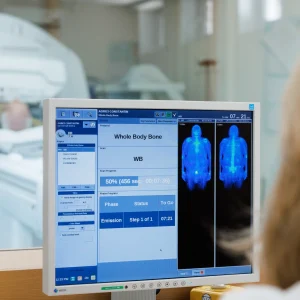
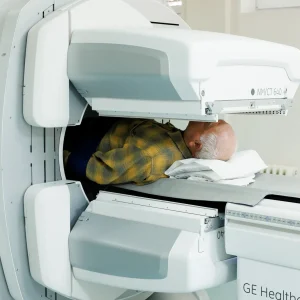
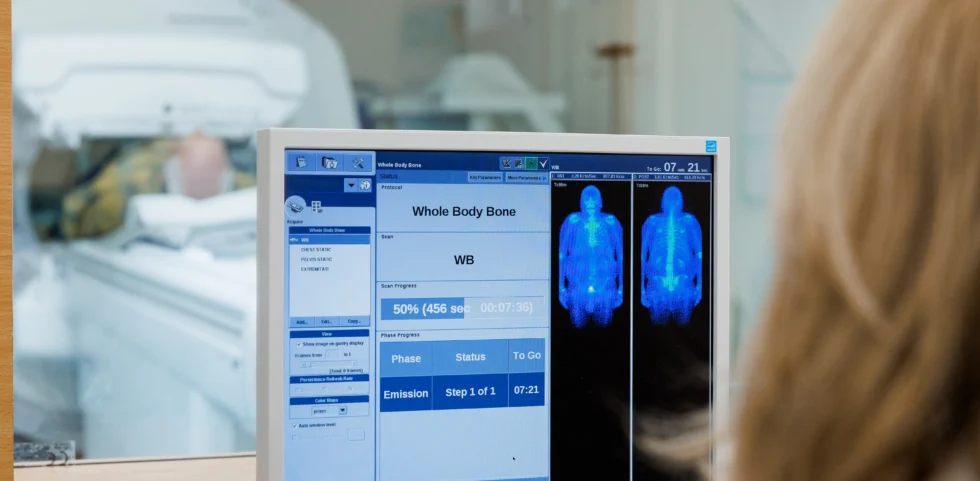
Principle of the method it consists of the intravenous administration of the radiopharmaceutical, which is distributed in the body according to the target organ, which emits gamma radiation detected by a gamma camera and images of the distribution of the substance are obtained that reflect the function of the organ.
Scintigraphy is a non-invasive method that evaluates organ function. The main indications include the detection of bone metastases/tumors (being the method of choice), monitoring lesions and assessing therapeutic response in oncological patients, evaluation of thyroid nodules/hyperthyroidism, evaluation of renal function, etc.
The following investigations are performed in the Nuclear Medicine Department:
- Scintigraphy of the osteoarticular system in the "WHOLE BODY" mode
- Thyroid scintigraphy with uptake test
- Thyroid scintigraphy with uptake test
- Renal scintigraphy in dynamic study
- Pulmonary perfusion scintigraphy
- Dynamic scintigraphy of the hepatobiliary system
| Investigation type | Preparation / Recommendations | Contraindications |
|---|---|---|
| Thyroid scintigraphy with uptake test |
|
|
| Thyroid scintigraphy with uptake test |
|
|
| "WHOLE BODY" osteoarticular system scintigraphy |
|
|
| Renal scintigraphy in dynamic study |
|
|
| Dynamic scintigraphy of the hepatobiliary system |
|
|
| Lung scintigraphy |
|
|
Thyroid scintigraphy with uptake test
Preparation / Recommendations
- The patient should be questioned about diet and medication that may influence the result.
- Check for recent exposure to iodinated contrast.
- Discontinuation of treatment 2–4 weeks in advance, on the recommendation of the endocrinologist.
- Avoiding iodine-based products 2–6 weeks beforehand.
Contraindications
- Contraindicated in pregnancy.
- Breastfeeding requires temporary interruption.
Thyroid scintigraphy with uptake test
Preparation / Recommendations
- It does not require special training.
- Check whether examinations with iodinated contrast have been performed in the last 6 weeks.
- Check for thyroid treatments or those containing iodine.
Contraindications
- Contraindicated in pregnancy.
- Breastfeeding requires temporary interruption.
"WHOLE BODY" osteoarticular system scintigraphy
Preparation / Recommendations
- Increased fluid consumption.
- Hydration minimum 0.5 L of water between injection and examination.
- Frequent urination.
- High fluid intake to eliminate the radiopharmaceutical.
- Avoid contact with young children and pregnant women for 24 hours.
Contraindications
- Pregnancy is an absolute contraindication.
- Temporary cessation of breastfeeding.
Renal scintigraphy in dynamic study
Preparation / Recommendations
- Hydration before the examination: 0.3–0.5 L of fluids.
- Diuretics are excluded.
- A full bladder is not required.
- Examination duration: approximately 20 minutes.
Contraindications
- Pregnancy is an absolute contraindication.
- Temporary cessation of breastfeeding.
Dynamic scintigraphy of the hepatobiliary system
Preparation / Recommendations
- Fasting 2–6 hours before the examination.
- Examination duration: approximately 90 minutes.
Contraindications
- Contraindicated in pregnancy.
- Temporary cessation of breastfeeding.
Lung scintigraphy
Preparation / Recommendations
- It usually does not require special preparation.
Contraindications
- Hypersensitivity to the active substance or excipients.
- Severe pulmonary hypertension.
- Temporary interruption of breastfeeding for 12 hours.
Recommendations for patient preparation:
General recommendations
- Inform your doctor about:
- Pregnancy or possibility of pregnancy or breastfeeding
- Ongoing medication or known allergies
Food
- For some investigations, fasting is required (e.g. 4–6 hours beforehand)
- For others, proper hydration is recommended
Medications
- Some medications may influence the results (e.g. thyroid medications)
- DO NOT stop treatment without your doctor's approval
Clothing
- Wear comfortable clothes
- Avoid metal objects (jewelry, belts)
During the investigation
- The radiopharmaceutical is administered (usually intravenously)
- There may be a wait time before scanning
- You must remain still during the examination
- The procedure is painless
After the investigation
- Drink plenty of fluids to flush out the radioactive substance
- Avoid prolonged contact with young children and pregnant women (24 hours)
Risks and safety
- The radiation dose is low and controlled
- Side effects are rare
- The investigation is considered safe
Result release
- Usually the same day
- The interpretation is performed by a nuclear medicine specialist